Preliminary Results
Preliminary Results for February 2026
February 2026
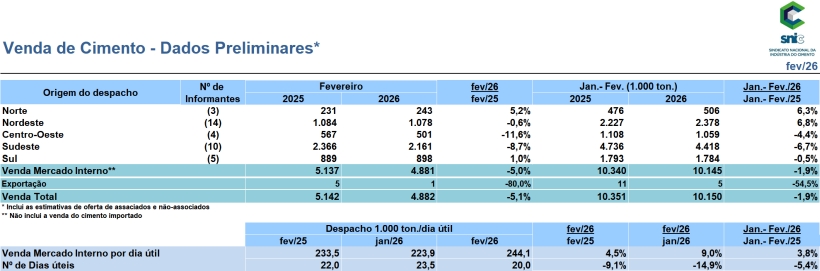
Cement sales in February 2026 totaled 4.9 million tons, registering a 5.1% drop compared to the same month in 2025, according to the National Cement Industry Union (SNIC). In the accumulated total for the first two months of the year, the sector showed a 1.9% contraction compared to last year.
The negative result at the end of the month is mainly due to two factors: the reduced calendar and the high volume of rain, especially in the Southeast and Midwest regions. On the other hand, the North and Northeast remain with strong performance.
However, demand remains strong: sales per working day rose 4.5%, reaching 244,100 tons. This data indicates that, despite the climatic obstacles, cement consumption per working day exceeded the performance of the previous year.
The sector still finds support in the strength of the real estate market and in employment and income indicators. Sales and launches of real estate reached record levels of 5.4% and 10.6% in 2025, respectively, with the Minha Casa, Minha Vida (MCMV) program standing out, now representing 52% of launches in the country. This scenario is reinforced by a labor market with unemployment that closed the year at 5.1%, the lowest level since 2012, and a record wage bill.
However, there was a drop in construction confidence¹ and consumer confidence². Household debt and the Selic rate maintained at 15% per year emerge as the main challenges to credit, evidenced by the 30.43% contraction in construction financing (ABECIP) in 2025. Adding to the sector's concerns is the growing shortage of labor on construction sites.
In the international context, the conflict in the Middle East is already impacting the price of oil and influencing the exchange rate and the cost of coke, an essential input for cement production. Given this scenario, the use of alternative fuels through co-processing becomes even more strategic. In Brazil, according to the Co-processing Panorama 2025 (base year 2024), this technology has already achieved approximately 30% thermal substitution via biomass, tires, and waste—avoiding the emission of 2.8 million tons of CO2 in the last year.
To support the cement sector's climate neutrality goal, ABCP and SNIC launched the Biomass Waste Mapping Tool (FMRB), a technological platform designed to enable the replacement of fossil fuels with renewable sources. Integrated into the Euroclima Program in Brazil, the project identified vast potential in 2,500 municipalities, aiming to eradicate the dumps and controlled landfills that still exist in many of these locations.
Beyond energy efficiency, the sector drives social housing through strategic partnerships, such as the cooperation between ABCP and the Housing and Urban Development Company – CDHU on the North Coast of São Paulo to modernize the Concrete Wall system. By qualifying the production chain for field industrialization, the initiative replaces conventional methods with a high-productivity model that reduces deadlines and waste. The result is a more durable structure, establishing a new standard of excellence and sustainability for social interest.
"At a time of great volatility in oil prices, the Brazilian cement industry reaffirms its leading role in the global energy transition by combining competitiveness and innovation. With the support of the Euroclima Program, we are advancing concrete solutions for structured decarbonization that strengthens the sector's long-term sustainability. We already operate with emission indicators significantly lower than the world average and, with the support of the waste mapping tool, we are paving the way to enable the large-scale replacement of fossil fuels and achieve climate neutrality by 2050." Paulo Camillo Penna – President of SNIC